
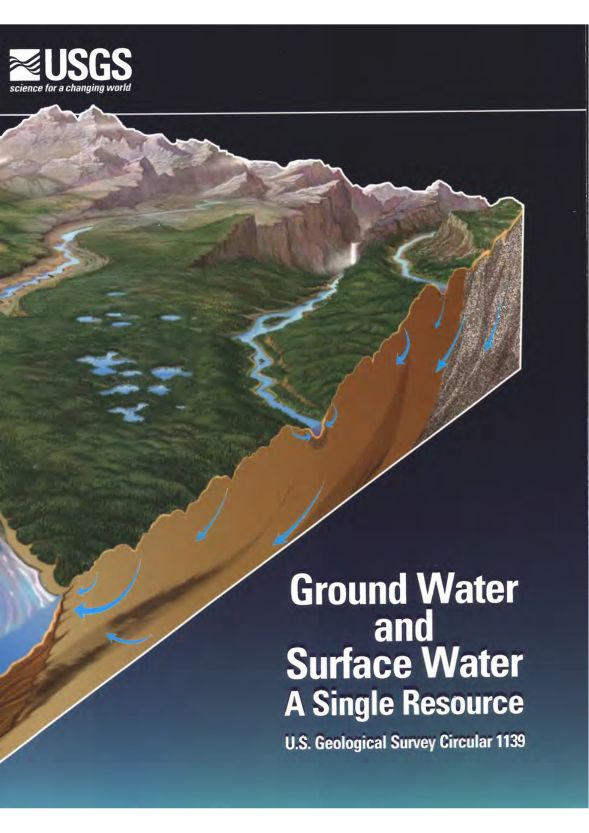

This U.S. Geological Survey Circular presents an overview of current understanding of the interaction of ground water and surface water, in terms of both quantity and quality, as applied to a variety of landscapes across the United States. It serves as a general educational document rather than a report of new scientific findings. Its intent is to help water-resources agencies build a firm scientific foundation for policies governing the management and protection of aquifers and watersheds. Effective policies and management practices must be built on a foundation that recognizes that surface water and ground water are simply two manifestations of a single integrated resource. It is our hope that this Circular will contribute to the use of such effective policies and management practices.
Traditionally, management of water resources has focused on surface water or groundwater as if they were separate entities. As development of land and water resources increases, it is apparent that development of either of these resources affects the quantity and quality of the other. Nearly all surface-water features (streams, lakes, reservoirs, wetlands, and estuaries) interact with groundwater. These interactions take many forms. In many situations, surface-water bodies gain water and solutes from groundwater systems and in others the surface-water body is a source of groundwater recharge and causes changes in groundwater quality. As a result, withdrawal of water from streams can deplete groundwater or conversely, pumpage of groundwater can deplete water in streams, lakes, or wetlands. Pollution of surface water can cause degradation of groundwater quality and conversely pollution of groundwater can degrade surface water. Thus, effective land and water management requires a clear understanding of the linkages between ground water and surface water as it applies to any given hydrologic setting.
Robert M. Hirsch, Chief Hydrologist (1999)