
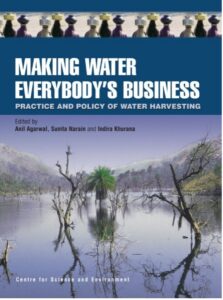
Making Water Everyone’s Business was first published in 2001 by the Centre for Science and Environment (CSE) and is now being shared by The Groundwater Project to ensure it reaches a global audience. The volume supplements the information provided in the citizens’ fourth report on the State of India’s Environment, ‘Dying Wisdom’. Dying Wisdom documented the rise, decline, and revival of India’s traditional water harvesting systems over the years, while this volume compiles case studies, policy analyses, and experiences from across India and around the world to demonstrate how rainwater harvesting can be established as both a local responsibility and through public policy.
The book is written by Anil Agarwal, founder-director of the Centre for Science and Environment, India’s leading environmental NGO; Sunita Narain, an environmental policy advocate and long-time director of CSE; and Indira Khurana, an environmentalist and water expert with experience in water management and conservation. Together, the authors discuss water usage and management through policies and community-based engagement. The work highlights the theme of environmental sustainability and links it with equity, decentralisation of water resources, and community participation.
The importance of this book’s topic lies in redefining drought and water scarcity. Rather than treating drought as simply a natural disaster, the authors argue that it is largely the outcome of manmade choices, caused by centralised control of water, overdependence on dams and groundwater extraction, neglect of groundwater recharge, and the decline of community responsibility. The book demonstrates that local rainwater harvesting is not just a paradigm of the past, but a modern solution, pulling together case studies and raw data from Rajasthan, Gujarat, Tamil Nadu, as well countries such as Sri Lanka, Japan and Singapore. The evidence of this movement as a solution to drought is powerful.
Methods such as utilising rooftops for water collection, installing artificial recharge technologies and treating domestic water not only provides a path to drought-proofing, local food security, and reduced flooding – but also is a way to strengthen community bonds. If rainwater harvesting is utilised the way it should be, then droughts should not exist throughout the country.
Making Water Everybody’s Business calls for decentralised water governance, legal frameworks that support the policies, community participation, and a shift in priorities from large-scale measures to local water supply structures. It combines both scientific technicalities, as well as legal and political messages on how this can be achieved by reducing reliance on the government.
The message concludes that water is not just a resource to be coveted, but a shared responsibility that can rebuild ‘social capital’, as coined by economists, as well as environmental resilience in a time of increasing climate uncertainty. It finally highlights the message that water is, indeed, everyone’s business.
The Centre for Science and Environment, the book’s publisher, is a public interest research organisation based in New Delhi that has played a key role in shaping India’s environmental advancements. Through policy research, public campaigns, and education and training, CSE has highlighted the urgency of sustainable and equitable development, founded on knowledge-based activism. CSE’s belief that water management must bridge knowledge, policy and community practice has been undertaken by the activists, engineers, policy makers and scholars brought together by the Potential of Water Harvesting conference that formed the basis of this book.
The centre hosts a comprehensive database on environmental science. It comprises courses, webinars, articles and many books that were published by the CSE. A very valuable knowledge resource database. We highlight the books ‘Drought? Try Capturing the Rain’ and ‘A Water Harvesting Manual for Urban Areas’. There are great learning materials for schools and teachers available under ‘Environmental Education’ topic. The book ‘Paving the Path’ showcases a selection of best environmental practices in schools across India. They also publish a bimonthly newsletter providing information on various activities undertaken by water harvesters in India and abroad, titled ‘Catch Water’.
This publisher has many other publications that may be of interest to readers. Please visit their website to learn more at:
To download the book visit: https://gw-project.org/books-category/preserved-books/