

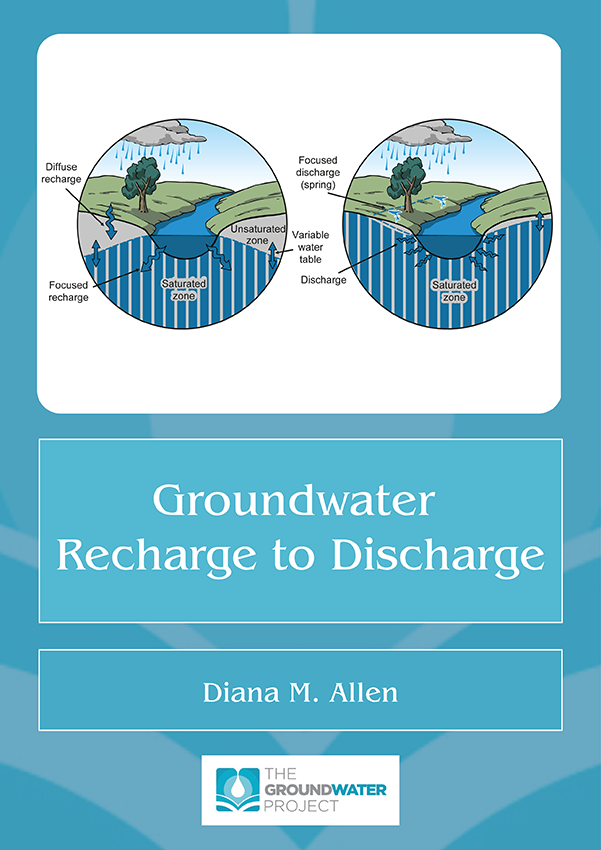
This book discusses two groundwater topics—recharge and discharge—in a focused, disciplinary fashion and in an interdisciplinary fashion. A key intention of this book is to draw linkages with other areas of the hydrological sciences—such as hydrometeorology, vadose zone hydrology, and surface water hydrology. Why? Because recharge and discharge are key components of the hydrologic cycle. The book also touches on the disciplines of biology and ecology by examining evapotranspiration and groundwater-dependent ecosystems. Following a general introductory chapter on the basics of recharge and discharge, three topics—diffuse recharge, discharge, and the dynamics of recharge and discharge—are discussed in detail. The chapter on diffuse recharge focuses on the partitioning of precipitation at the land surface, beginning with an overview of weather and climate and the characteristics of precipitation. This overview is then followed by a detailed examination of evaporation and transpiration, infiltration through the vadose zone, and streamflow generation. The next chapter focuses on the different forms of discharge and gives an overview of groundwater exchanges with surface water. The following chapter on the dynamic nature of recharge and discharge begins with understanding groundwater-level hydrographs and changes in storage. It explores these dynamics at different temporal scales (sub-daily to long-term), including the consideration of interactions with surface waters. In addition, methods for estimating recharge and discharge are summarized. In the final chapter, human influences—such as groundwater abstraction, irrigation, and managed aquifer recharge—are discussed, as well as groundwater dependent ecosystems, and issues of groundwater and climate change relative to alterations of recharge and discharge.
Groundwater Recharge to Discharge
Publication year: 2026
Number of pages: 195
ISBN: 978-1-77470-142-3
https://doi.org/10.62592/GUTB8590
Citation: Allen, D. M. (2026). Groundwater Recharge to Discharge. The Groundwater Project. https://doi.org/10.62592/GUTB8590.
Author:
Diana M. Allen: Simon Fraser University, Canada
Please donate to support us in providing free high-quality education to the global groundwater community.
Thank you,
John Cherry
Description
Thank you for signing up to our email list!
Contents
1 RECHARGE AND DISCHARGE IN THE FLOW SYSTEM
1.1 What is Groundwater Recharge?
1.2 What is Groundwater Discharge?
1.3 Recharge and Discharge Areas in the Groundwater Flow System
1.4 Summary
2 PROCESSES CONTROLLING DIFFUSE RECHARGE
2.1 Partitioning of Precipitation at the Earth’s Surface
2.2 Climate and Weather
2.2.1 Describing Climate and Weather
2.3 Precipitation
2.3.1 Moisture-Holding Capacity of the Atmosphere
2.3.2 Characteristics of Precipitation
2.4 Evapotranspiration
2.4.1 Energy at the Earth’s Surface
2.4.2 Evaporation
2.4.3 Evaporation from Different Surfaces
2.4.4 Transpiration
2.4.5 PET versus AET
2.4.6 Evapotranspiration Measurement Methods
2.5 Infiltration Through the Unsaturated Zone
2.5.1 Capillarity and the Matric Potential
2.5.2 Moisture Characteristic Curve
2.5.3 Hydraulic Conductivity of Unsaturated Soils
2.5.4 Darcy’s Law
2.5.5 The Infiltration Process
2.5.6 Quantifying Infiltration
2.6 Redistribution and Recharge
2.7 Streamflow Generation
2.8 Summary
3 GROUNDWATER DISCHARGE AND EXCHANGES WITH SURFACE WATERS
3.1 Discharge Mechanisms
3.1.1 Exchanges Between Groundwater and Surface Water – An Overview
3.1.2 Groundwater Discharge to Streams
3.1.3 Discharge to Lakes and Wetlands
3.1.4 Discharge to Saline Bodies of Water
3.1.5 Springs and Seeps
3.1.6 Geysers
3.1.7 Flowing Wells
3.1.8 Groundwater Abstraction
3.2 Factors that Control Discharge
3.3 Summary
4 THE DYNAMIC NATURE OF RECHARGE AND DISCHARGE
4.1 Recharge and Discharge Lead to Changes in Storage
4.1.1 The Groundwater Level Hydrograph
4.1.3 Methods Used to Estimate Recharge, Discharge, and Changes in Storage
4.2 Seasonal Variations in Timing and Distribution of Recharge and Discharge
4.2.1 Cold Continental Climate
4.2.2 Temperate Climate
4.2.3 Arid and Semi Arid Climate
4.3 Variability of Recharge and Discharge at other Temporal Scales
4.3.1 Subdaily to Daily Variability
4.3.2 Variability Over Longer Periods
4.4 Dynamic Interactions Between Streams and Aquifers
4.5 Summary
5 ALTERATION OF NATURAL RECHARGE AND DISCHARGE
5.1 Groundwater Abstraction
5.2 Irrigation
5.3 Managed Aquifer Recharge
5.4 Recharge, Discharge, and Ecological Systems
5.5 Impacts of Climate Change on Recharge and Discharge
5.6 Summary
6 WRAP-UP
7 EXERCISES
8 REFERENCES
9 BOXES
BOX 1 – The Hidden Recharge From Mountains
Box 2 – Groundwater Recharge In Cold Regions
Box 3 – Modeling Hypothetical Infiltration Event And Overland Flow
Box 4 – Coastal Groundwater Discharge
Box 5 – Thermal Springs In Southwestern Canada
Box 6 – Water Table Fluctuation Method For Estimating Recharge
Box 7 – Mountain Block Recharge In The Andes Of Peru
Box 8 – Monitoring Groundwater Storage Changes From Space
Box 9 – Modeling Recharge And Discharge
Box 10 – Depression Focused Recharge
Box 11 – Atmospheric Rivers
Box 12 – Groundwater-Level Responses To Atmospheric Pressure Fluctuations And To Air Entrapment
Barometric Pressure Fluctuations
Air Entrapment – The Lisse Effect
Box 13 – Seasonal Variations In Groundwater Flow Patterns Near A Willow Ring
Box 14 – Dynamics Of Climate–Groundwater Stream Interactions
Box 15 – How Plants And The Critical Zone Regulate Groundwater Recharge And Discharge In Seasonally Dry Climates
10 EXERCISE SOLUTIONS
11 NOTATIONS
12 ABOUT THE AUTHOR
Thank you for signing up to our email list!