
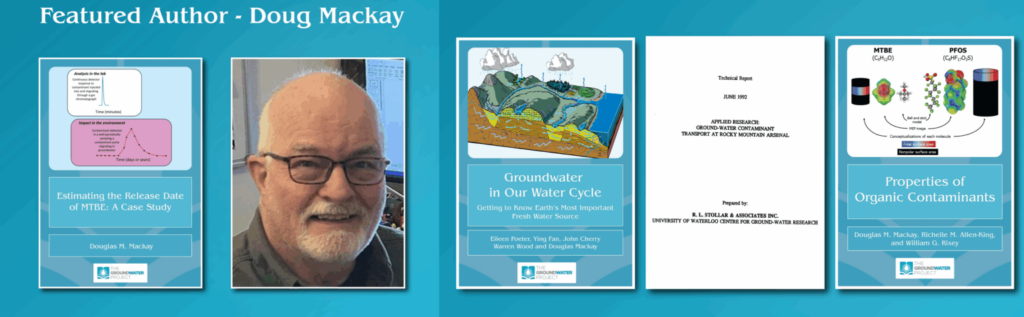
Douglas M. Mackay is an Adjunct Professor Emeritus in the Department of Land, Air & Water Resources at the University of California, Davis. Since 2020, he has published three books with The Groundwater Project and has included a 1992 publication in the preserved book section. His most recent book is a case study that investigates the release and fate of MTBE at a site – an engaging piece of investigative work that is freely available to our community worldwide. We also share a full interview about this case study on our YouTube channel. In it, Doug explains how MTBE was not initially considered a possible contaminant at the site and was eventually identified as a “mystery contaminant.” To solve the mystery, the investigation set out not only to identify the contaminant, but also to reconstruct its release history in a multi-aquifer system. This is a valuable case to study and an approach worth adding to your toolbox.
Background and Work
Doug Mackay is a leading figure in contaminant hydrogeology. His research has focused on groundwater contamination and remediation, often drawing on highly detailed field investigations of existing contamination and on carefully controlled field experiments. Over his career, he helped educate and mentor generations of hydrogeologists, working alongside students, staff, colleagues at other universities, and professionals in consulting firms. He treated the field as a laboratory, demonstrating the value of field-scale studies for understanding contaminant fate and transport in real geological settings.
He also worked on existing contaminant plumes, including the evaluation of remedial technologies such as permeable reactive barriers (PRBs), pump-and-treat alternatives, and bioremediation stimulated by oxygen or other gases. His research also addressed the estimation of natural source-zone depletion (NSZD) and the effects of co-occurring compounds on biodegradation, among other topics.
One field site well known to hydrogeologists worldwide, the Borden Research Site, was among the locations where these studies were conducted and where key advances in contaminant hydrogeology were established. Other locations included The Rocky Mountain Arsenal (Colorado), Dover Air Force Base (Delaware), Vandenberg Air Force Base (California), and former gasoline service stations in Ontario and in Santa Clara Valley (California). His controlled field experiments examined transport, sorption, and transformation during the release of methane, gasoline, gasohol, chlorinated and brominated hydrocarbons (including TCE and PCE), and herbicides (such as alachlor, propachlor, atrazine, and simazine).
Doug and The Groundwater Project
After retiring from the University of California, Davis, Doug has devoted himself to writing the books now available on our platform. He values clear understanding and emphasizes communicating knowledge in language that anyone can fully grasp.
For this reason, he sees The Groundwater Project as an important way to make this knowledge accessible to a broad audience worldwide.
We are grateful for, and proud to highlight, Doug Mackay’s lifetime contributions to advancing contaminant hydrogeology, including the study of contaminant fate, transport, and remediation, and for the impact of his work on students and professionals worldwide.
You can explore Doug’s books on our website:
- Groundwater in Our Water Cycle: Getting to Know the Earth’s Most Important Freshwater Source — E. Poeter, Y. Fan Reinfelder, J. Cherry, W. Wood, and D. Mackay (August 21, 2020) – also available in Catalan, Italian and Turkish
- Properties of Organic Contaminants — D. Mackay, R. Allen-King, and B. Rixey
- Estimating the Release Date of MTBE: A Case Study — D. Mackay (July 2025) – also available in Arabic and Spanish
- Applied Research: Groundwater Contaminant Transport at Rocky Mountain Arsenal — B. Myller, G. Bianchi-Mosquera, B. Honeyman, and D. Mackay (R. L. Stollar & Associates Inc., 1992)