
Regarding underground water resources, Paraguay has three major groundwater extraction aquifers within the La Plata Basin: firstly, the Patiño Aquifer located in the central part of the country; then the Misiones Aquifer, a component of the Great Guaraní Aquifer System shared with Brazil, Argentina, and Uruguay; and the Yrendá Aquifer in the Central Chaco, a component of the Great American Chaco, shared with Bolivia and Argentina, where in the latter country it is called the Toba Aquifer (Monte Domecq and Báez Benítez, 2007).
Paraguay’s aquifer systems can be classified according to their lithological nature and hydraulic properties into (Godoy and Paredes):
- Aquifers permeable due to intergranular porosity, and
- Aquifers permeable due to rock fracturing, conditioned by geological structures and karstification processes
Within the system of aquifers permeable due to intergranular porosity are:
*Chaco Yrenda Aquifer
*Patiño Aquifer
*Misiones Aquifer
*Caacupé Aquifer
Among these aquifers, those of greater importance due to their strategic location, dimensions, and utility are: the Guaraní Aquifer and the Patiño Aquifer.
– Guaraní Aquifer:

Montaño et al. mention that the Guaraní Aquifer System (GAS) represents one of the most important freshwater reserves in the world. It is a transboundary aquifer with an area of 1,200,000 km2 shared by four countries: Argentina, Brazil, Paraguay, and Uruguay. It consists of a set of sandy rocks located below ground level that hold water in their pores and fissures. These rocks were deposited there between 245 and 144 million years ago (Guaraní Aquifer System – ICAA).
The water found in the confined area is used to meet the demand of thermal centers and could be used for industrial purposes. The outcrop area is important as a high-quality water source for public supply to medium and large cities. In recent decades, the use of groundwater in both regions has grown exponentially, mainly in the outcrop area (Montaño et al. n.d.).
– Patiño Aquifer:
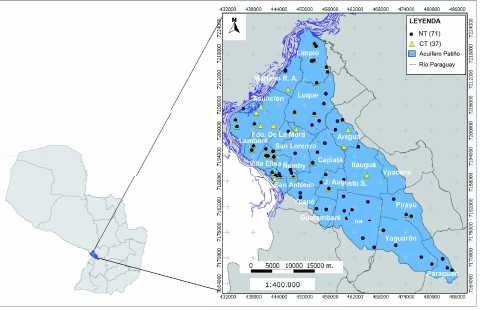
Source: Báez et al. 2014

REFERENCES
Arraval and Álvarez (2019):
https://publications.iadb.org/publications/spanish/document/Estudio_de_recursos_h%C3%ADdricos_y_vulnerabilidad_climática_del_acu%C3%ADfero_Patiño_es.pdf
Báez Lovera, LV; Villalba Cardozo, C.; Nogues Peña, JP. 2014. Mapping the Vulnerability and Risk of Groundwater Contamination in Greater Asunción (online). National University of Asunción, Asunción, PY. Consulted Apr 19, 2017. Available at 139 http://opengeo.pol.una.py/descargas/Informe%20Final%20Politecnica%20INV20.pdf
Godoy and Paredes:
https://www.geologiadelparaguay.com.py/Acuiferos-Potenciales-del-Paraguay.pdf
Monte Domecq and Báez Benítez, 2007: CA0443ES.pdf (fao.org)
Guaraní Aquifer System – ICAA: https://icaa.gov.ar/sistema-acuifero-guarani/