
GROUNDWATER, TECHNOLOGY, AND PURPOSE: A CONVERSATION WITH DR. MOHAMED GAD
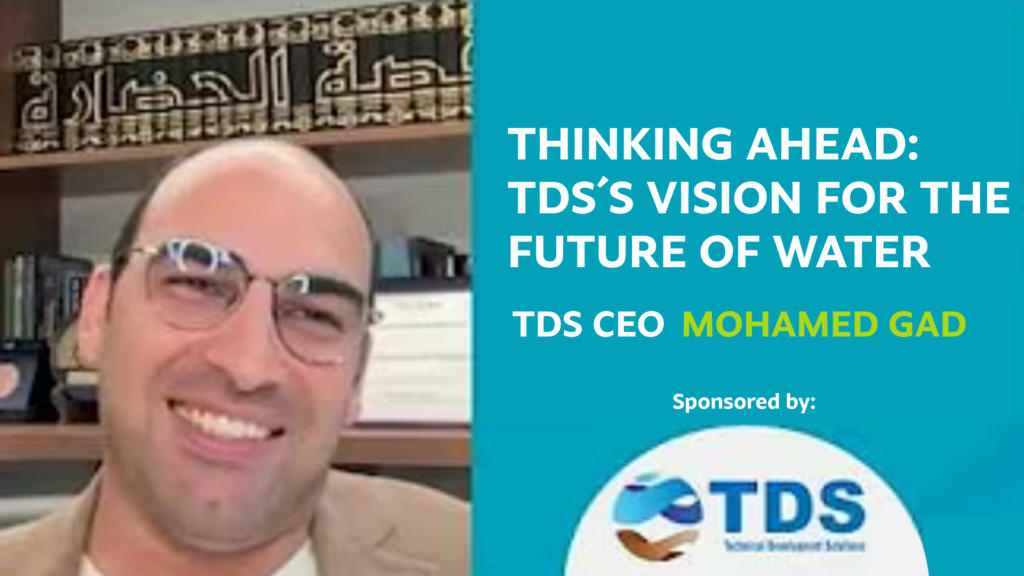
What happens when a business leader from the Middle East decides that knowledge about groundwater should not be a privilege for the few? The answer lies in the journey of Dr. Mohamed Gad, CEO of TDS (Technical Development Solutions) — the consulting arm of the Al Mousa Group, a Saudi conglomerate with over 50 years of history.
In an inspiring interview with the Groundwater Project, hosted by Dr. Everton de Oliveira, Dr. Mohamed Gad shared his vision on sustainability, technology, and the transformative power of knowledge.
From Geophysics to Sustainability
Dr. Mohamed Gad’s passion for sustainability didn’t start with slogans. It began in the field, in arid regions, where he saw entire communities living on top of major aquifers without knowing their condition, quality, or how long they could sustain them.
“I learned that finding groundwater is just the first step. We need to know how much water we have, how it’s recharged, how its quality changes, and how our use today affects the next generation.”
This realization shifted his career, from pure geophysics to integrated monitoring models, data management, and long-term planning. For him, sustainability means using water with knowledge and responsibility.
Technology: Making the Invisible Visible
At TDS, technology is the engine that turns data into decisions. The tools are many: geophysics, monitoring sensors, telemetry, GIS (Geographic Information System), remote sensing, groundwater models, and increasingly Artificial Intelligence (AI) for data quality verification.
“Technology alone is not the solution. Installing a sensor and forgetting about it does not protect groundwater. The true value of technology is not in how much data we collect, but in the quality of decisions we make from that data.”
TDS is at the forefront: they now manufacture their own sensors using IoT (Internet of Things) and AI, use NMR (Nuclear Magnetic Resonance) for permeability data (replacing dangerous radioactive sources), and deploy drones for groundwater exploration.
Knowledge Is Not a Privilege
One of the most powerful moments of the interview reveals Dr. Mohamed Gad’s deepest motivation. When asked why he became the largest sponsor of the Groundwater Project, he recalled:
“When I was a young student, there were important scientific books I wanted to read but couldn’t always afford. Knowledge should never be a privilege based on where you live or how much money you have.”
TDS became a Diamond sponsor of the project, not for marketing, but as an investment in human capacity. As he put it: “The student who receives an excellent book today may become the hydrogeologist who protects a major aquifer tomorrow.”
TDS: The Complete Story of Groundwater
TDS operates in four areas: Water, Environment, Mining, and Green Energy, but water has always been the heart of the business. The company describes its work as “the story of groundwater,” covering:
Location and drilling (geophysics, hydrogeology)
Post-drilling services (well logging, pumping tests)
Government scale (monitoring networks, national strategies)
Non-conventional water resources (aquifer storage, saltwater intrusion studies)
Among its flagship projects, TDS is responsible for thousands of hydrological monitoring stations across Saudi Arabia, integrated water resource management in Tanzania, and the baseline contamination and saltwater intrusion studies for the mega-project NEOM on the Red Sea.
Three Levels for a Sustainable Future
In his closing message, Dr. Mohamed Gad calls on companies, governments, and institutions to collaborate on three levels:
Academic — Education and capacity building
Industry — Funding and support to initiatives
Government — Regulation and public policy
“It’s not just about presenting a project and getting funding. We have a much greater responsibility to our communities and to the world we live in.”
Watch the Full Interview
This was just a sample of the conversation. To dive into all the details, including TDS’s innovative organizational structure, the challenges of adapting technology to local Middle Eastern conditions, and Dr. Mohamed Gad’s leadership philosophy, watch the full video on our YouTube channel.